Search This Blog

Showing posts with label videogame law. Show all posts

Wednesday, August 17, 2016

Michigan Residents File Pokemon Go Class Action Lawsuit

The attorneys at Pomerantz Law are at it again, and are attorneys of record in a Michigan class action lawsuit against Niantic and Nintendo. The allegations in the Michigan complaint overlap significantly with those in a Massachusetts class action lawsuit that I blogged about at the beginning of August filed by a Massachusetts resident. Both complaints were filed in the District Court for the Northern District of California.

Click On Detroit reports about the new class action -- which also alleges causes of action for nuisance and unjust enrichment -- filed by a Michigan couple living in St. Claire Shores, a suburban town located near Detroit that will be holding a Fence Arbitration meeting today for those who may have forgotten to mark their calendars. Reporting by Bloomberg Markets (on the lawsuit, not the Fence Arbitration meeting) can be found here.

A copy of the Complaint can be found attached to the Click on Detroit article. Its substance significantly overlaps with the Massachusetts Complaint, and it too includes multiple bold, italicized mentions of how "Niantic even placed three Pokéstops within the United States Holocaust Memorial Museum." That part never gets old.

One improvement in the Michigan Complaint is that it has more facts regarding how Pokémon Go affected the plaintiffs' lives. As you may recall, the Massachusetts Plaintiff's allegations were little more than a complaint about several people walking near his house and knocking on his door on a few occasions. The Michigan Complaint is more detailed. The factual allegations are largely copied from letters the Plaintiffs wrote to Niantic, and here is an example of some of that quoted language. Trigger warning: bold italics:

At any given moment there are at least a couple of hundred people in the park play[ing] this game, compared to the average of at least 15-20 in the park. The [Pokéstops and Pokémon gyms] . . . [are] an open invitation for the players to utilize our street, our lawns, looking in our windows . . . and so forth. There are at least 30 homes . . . that are affected by this. These players are loud, make threats, [are] intrusive, and I do not feel safe. My husband and I moved to our home almost two years ago because it was peaceful, quite, and safe. When I see people driving slow, looking into our home, walking on our property, looking into our vehicles, we do not feel safe. Neither do the neighbors. . . .

. . .

With all the traffic it is hard to tell who is playing the game, or casing out our street/park, someone who is looking to rob, rape or any other harm. . . . They park along our street that borders Wahby Park, we ask them to move and get threats and attitudes. I was threatened by a man who refused to leave. He was parked in front of my home. I had hardly any room to back out of my driveway. Mind you, he was also parked the wrong way on the street. . . . I truly hope you will take this into consideration, the news has already been in the park twice, and have interviewed neighbors on this issue.
To paraphrase, the plaintiffs live near Wahby Park which, in addition to being a great place for weddings, allegedly has six PokéStops, where players can collect items and place "lures" that attract Pokémon. This has led to a crisis of numerous people going to the park, and wreaking havoc in the surrounding neighborhood. Plaintiffs allege that players are walking on their yards, blocking driveways, and even include a picture of a potential hipster giving side-eye to the camera.

Yikes.

Plaintiffs seek to establish a class and use the same definition as the Massachusetts Plaintiff, which is:
All persons in the United States who own property (i) the GPS coordinates of which were designated by Defendants, without authorization, as Pokéstops or Pokémon gyms in the Pokémon Go mobile application or (ii) abutting property the GPS coordinates of which were designated by Defendants, without authorization, as Pokéstops or Pokémon gyms in the Pokémon Go mobile application.
For reasons I explain at length in this prior post, I think this class definition is likely to fail.

For a reason specific to this lawsuit, though, I think this Complaint has faces an additional, serious problem because the named plaintiffs do not appear to fall into the class. The plaintiffs include an illustration of the neighborhood as it appears in the app:
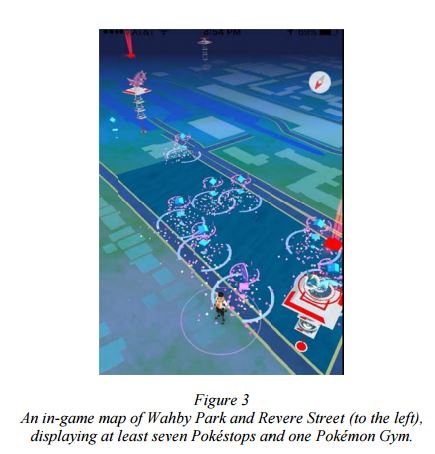


From this illustration, it appears that all of the PokéStops and Gyms are in the park, which is public property. The park is separated from all surrounding homes by a road. Accordingly, there appear to be no areas of private property that "abut" PokéStops or Gyms. This is a problem for the Complaint as a whole because the lead plaintiffs need to be members of that class. Plaintiffs might argue that their property falls within the 70-meter radius where people can interact with the stop or the gym, but this does not appear to fit the fairly specific, GPS-coordinate-based class definition.

I will continue to monitor both Pokémon Go class action lawsuits, and I will do my best to post updates as they proceed. I suspect that the plaintiffs in both will face some significant obstacles, but the law firm spearheading this effort doesn't appear to be slowing down at this point.

Tuesday, August 2, 2016

Evaluating the Pokemon Go Class Action Lawsuit

Several news outlets have reports on Marder v. Niantic, Inc., filed July 29, 2016 in the Federal District Court for the Northern District of California. A copy of the complaint is available here.

Coverage of the complaint is available here, here, here, and here, although the Boston Herald seems to have the most direct quotes from various people involved in the suit or otherwise wronged by Niantic's Pokemon Go app.

The Complaint outlines Pokemon Go's success, but notes that the game places "PokeStops" and "Gyms" -- locations that attract players -- on or near private property. The Complaint states that Niantic "blithely" acknowledges that players may trespass, although a round of updates a few days ago added more explicit admonishments against trespassing. The Complaint also notes several times in bold and italicized letters that "Niantic even placed three Pokéstops within the United States Holocaust Memorial Museum."

Strong stuff.

The Complaint goes on to describe the terrors inflicted on the named Plaintiff, Jeffrey Marder:

In the days following the U.S. release of Pokémon Go, Plaintiff became aware that strangers were gathering outside of his home, holding up their mobile phones as if they were taking pictures. At least five individuals knocked on Plaintiff’s door, informed Plaintiff that there was a Pokémon in his backyard, and asked for access to Plaintiff’s backyard in order to “catch” the Pokémon.
The Complaint goes on to cite other instances of Pokemon Go causing people to drive or park near people's houses, and again notes that "Niantic placed at least three Pokéstops within the United States Holocaust Memorial Museum in Washington, D.C." (emphasis [unfortunately] in the original).

Interestingly, one of the stories the Complaint cites is that of Boon Sheridan, whose house used to be a church. Sheridan reported that the game made his house into a Gym and that many players would park outside or drive slowly past. The Boston Herald managed to get in touch with Sheridan, however, and he stated that he complained to Niantic who removed the Gym designation from his house within 48 hours. Sheridan further stated that he likely would not join Marder's lawsuit.

The Complaint alleges causes of action for nuisance (invasion of the use and enjoyment of one's land) and unjust enrichment (Defendants received monetary benefits from their alleged tortious conduct). The Complaint seeks class action status for the class defined as:
All persons in the United States who own property (i) the GPS coordinates of which were designated by Defendants, without authorization, as Pokéstops or Pokémon gyms in the Pokémon Go mobile application or (ii) abutting property the GPS coordinates of which were designated by Defendants, without authorization, as Pokéstops or Pokémon gyms in the Pokémon Go mobile application.
While I will readily acknowledge that the intricacies of class action litigation are not the focus of my legal practice or research, my initial reaction is that this class definition will face an uphill battle in proving commonality among the class members. Like the class members in Wal Mart v. Dukes who were thwarted by the jump from an individual experience of sex discrimination to a business-wide policy of discrimination, here, the Plaintiff must show that class members living on or near property designated as PokeStops suffer a similar loss of enjoyment of their land. This will be difficult for Plaintiff to show.

I base this assessment on the game's design and Plaintiff's choice to limit the class definition to Plaintiffs owning property near Gyms and PokeStops. Plaintiff will be hard-pressed to show that class members tend to have people knocking on their doors in search of Pokemon as a result of PokeStops or Gyms placed on the property. Off the bat, Gyms are not a source of catching Pokemon -- players simply need to be within a certain distance of the Gym in order to interact with it. That distance used to be 100 meters, after the latest round of updates, it is apparently 70 meters. Even with the decreased distance, there should often be no need to approach or knock on the door of the property where the Gym is located.

If the property has a PokeStop, it may be the location of a "lure" module which increases the frequency of Pokemon appearing within a radius surrounding that location -- but again, the 70-meter radius is often large enough that players need not be inside the property (or within its curtilage, if I may borrow from Fourth Amendment law) to take advantage of the lure. Players can likely stand nearby on a sidewalk which, while potentially aggravating to an ornery landowner, does not appear to amount to a loss of enjoyment of the property. After all, people normally walk, stand, and allow their dogs to defecate on and near sidewalks. Increased foot traffic and the occasional presence of nostalgic hipsters is not much of a change.

In previous posts, I criticized New York State Senators for allowing their staff members to play Pokemon Go for weeks in order to generate ill-conceived policies to combat problems that do not exist. Here, however, I feel that Plaintiff and his attorneys would have done well to play the game a bit more before filing this class action. Doing so would reveal the significant obstacle to establishing the commonality element of his class definition.

And, after all, isn't this exactly what summer associates are for?

Thursday, July 24, 2014

Criminal Punishment for the Theft of Virtual Items?

From Erica Buist at The Guardian:

All right, own up: did you steal Mike Weatherley's sword on World of Warcraft? If so, you'd better watch out. He's really upset about it. So much so that, as David Cameron's chief adviser on intellectual property, he has asked ministers to consider passing a law that would mean people "who steal online items in video games with a real-world monetary value receive the same sentences as criminals who steal real-world items of the same monetary value".

. . .


"If you've spent £500 building up your armed forces and someone takes them away online, I guess you can feel hard done-by and you want your £500 back," he told Buzzfeed. He also pointed out: "The perception from some people is that if you steal online it's less of a crime than if you steal physically." 
It's hard to argue with his logic. Gamers spend a lot of money on virtual items, and invest time in building armed forces or gigantic warships. These things may be nothing more than a collection of pixels on a screen, but the money isn't virtual, and neither is the time, or the feeling of having been robbed.
Buzzfeed also covers this proposed law.

I agree that some aspects of online theft are similar to theft in the real world. Many online items are purchased with real money. Thieves can steal these goods under the pretense of exchanging or trading items, but then leaving upon receipt of the valuable goods. This entry in a World of Warcraft forum is an example of such a fraudulent transaction. Law students studying for the bar should recognize this as something resembling the quirky crime of larceny by trick.

But there are crucial differences between the theft of physical items or money and the theft of virtual goods in an online environment. Blizzard, the company that makes many of these online games, warns players of these online scams, but also says that they will "assist where possible" when a scam can be verified. And as the players in the earlier forum mention, if there is a chat record that details the fraudulent transaction, the player can usually receive another copy of their virtual good, and the person who stole the good will probably be banned.

If somebody can receive an identical copy of their stolen good once it is stolen, and if offenders face effective exile from the online world in which the theft takes place, I am not sure that prosecuting online thieves would be a constructive undertaking. It makes sense to criminalize online theft that results in the loss of money from a person's bank account (say in instances of identity theft). But when the theft deprives somebody of a virtual item that can be replaced with an identical item without cost to the website, the theft, while fraudulent, does not seem to cause enough harm to warrant criminal prosecution.

Thursday, May 22, 2014

Blizzard Suing the Makers of Starcraft II Cheats and Hacks

The BBC reports:

Activision Blizzard is trying to sue hackers who have created cheats for its Starcraft II video game. 
The publisher says the software undermines online multiplayer battles and could cause players to lose interest in the title.
The full complaint is available here.

Blizzard argues that those who make the cheats for Starcraft II infringe Blizzard's copyrights by copying or recreating the game in the process of manufacturing the cheats. Moreover, Blizzard's terms of use for its online competitors prohibit users from making "cheats, automation software (bots), hacks, mods, or any other unauthorized third-party software designed to modify the Service, any Game, or any Game experience." Blizzard argues that makers of cheats know that this contract exists, and that the makers of cheats induce Starcraft II players to violate their contracts, which undermines the game's legitimacy. The hackers Blizzard is suing are those who are able to circumvent Blizzard's "Warden" security measures which generally prohibit players from using hacks and modifications.

Blizzard has sued makers of mods before. In 2013, the company won a lawsuit against Ceiling Fan Software, which had manufactured a bot for World of Warcraft players. The District Court for the Central District of California's ruling is available here. The bot would allow the World of Warcraft players' online characters to "engage in repetitive and elongated play" of the game, which would allow players to obtain experience and "virtual currency" over "periods of time impossible for human players (for example, through the night or for hundreds of hours without interruption)" (apparently the court was not familiar with the habits of some human players of World of Warcraft).

In its lawsuit against Ceiling Fan, Blizzard argued that these bots violated the same terms of use that Blizzard is raising in its current lawsuit against the Starcraft II hackers. The court held that Ceiling Fan's bots and their distribution of the bots was tortious interference with the Terms of Use contracts to which World of Warcraft players had agreed. The court that decided the Ceiling Fan case is the same court in which Blizzard has filed its lawsuit against the Starcraft II hackers.

While I am not familiar enough with the mechanics of manufacturing cheats, bots, and hacks to know if Blizzard's copyright claims will succeed, it looks like Blizzard has a pretty good chance of arguing that the defendants interfered with its terms of use contracts.