Search This Blog

Showing posts with label Pokemon Go. Show all posts

Thursday, August 25, 2016

Illinois "Pidgey's Law" an Overly Hasty, Muddled Attempt at Regulating Augmented Reality

Several news outlets have reports on this bill (AB 6601) recently introduced by Illinois State Representative Kelly Cassidy. Nicknamed "Pidgey's Law," the bill was introduced in response to reports that players of the augmented reality game, Pokémon Go, were trampling the habitats of endangered species in a federal park.

From the Chicago Sun Times:
Cassidy introduced “Pidgey’s Law” on Wednesday during a news conference at the Loyola Dunes Restoration Site. Named after one of the game’s bird Pokémon, the bill aims to crack down on location-based game developers to remove problematic gaming sites from their maps.
. . .  
If passed, “Pidgey’s Law” would give game developers up to two days to remove a location-specific site from its game if that site’s property owner, manager or custodian requests its removal. After that, developers would be fined up to $100 each day until the stop is removed. 
The bill is in response to a Pokéstop — real-life locations gamers can visit for in-game perks — that rests at the center of the dune restoration area, which is protected under state and federal law. The stop, based on an art installation that stood there a few years back, sometimes draws players off the designated path into areas where some endangered wildlife lives. 
The hundreds of Pokémon Go players who frequent the area each night have caused increased littering and vandalism as well as occasional trampling of the wildlife when rare Pokémon appear in the augmented reality of the game.
Other news outlets report on the bill here, here, and here. A common theme in all of this reporting is that the purpose of the bill is to remove in-game landmarks (in Pokémon Go these are known as Gyms and PokéStops) from private property or environmentally sensitive areas at the request of property owners or managers.

But is this what the bill actually does? Below are the pertinent sections of the bill. To make efficient use of these extensive quotes, I've emphasized the terms that are either undefined or that cause problems:

Friday, August 19, 2016

"Virtual Property," "Virtual Trespass," and Nuisance Law: A Pokémon Go Story

This post is a spinoff from some of my recent posts on Pokémon Go litigation which you can find here and here. Pokémon Go's popularity and related litigation has prompted commentators to discuss notions of "virtual property," and related questions of who owns virtual property and whether it can be invaded in instances of "virtual trespass." I think that "virtual property" and "virtual trespass" are poor choices of wording that lead to confused discussions and the breakdown of legal analysis.

My suggestion: stop using these terms. Rather than "virtual property," instead say, "right to enjoyment of property." Rather than "virtual trespass," instead say, "interference with the right to enjoyment of property." In short, nuisance law provides an effective avenue for coherent legal treatment and analysis of Pokémon Go and other augmented reality games. Notions of trespass lead to confusion and unanswerable questions.

For the story that prompted these legal musings, CTV News reports:
A French mayor has denounced the "anarchical settlement" of "Pokemon Go" characters on the "territory" of his eastern village and has ordered the game's creator to remove the virtual creatures.

Bressolles Mayor Fabrice Beauvois said Tuesday that he has mailed a decree to California-based Niantic Inc. and The Pokemon Company to make sure they stop setting up Pokemons [sic] in the village of about 800 inhabitants northeast of Lyon.

In his decree, the mayor says the search for Pokemons [sic] puts pedestrians and drivers at risk because players get inattentive while watching their smartphones and that it may also result in groups of people forming at night
You can find additional reporting on the decree here and here.

The article goes on to note that while Niantic has not responded regarding the mayor's request, Niantic has pointed out that people can request that the company remove a location's designation as a Gym or PokéStop. This solution, however, would not address that mayor's concern, who is requesting that the "territory" of his village be removed from the App's augmented reality altogether.

Here's the logic the mayor used:

"When a cafe or a restaurant owner wants to open a business in any French town, they have an obligation to request prior authorization to the mayor. The rule applies to all people wishing to set up an activity or occupy a space on a public property. So it applies to Niantic as well, even though their settlement is virtual," Beauvois said.

The argument illustrates an interesting question: does Pokémon Go's placement of interactive locations and randomly-generated digital creatures onto a map constitute trespass or interference with property rights? Keith Lee confronts this question in this excellent article.

One of the particularly interesting questions Lee raises goes as follows:

You might argue that [Augmented Reality] object[s] aren’t real. That they don’t constitute a physical invasion of property. But:
  • To recover in trespass for an intangible invasion to property, a plaintiff must show: (1) an invasion affecting an interest in exclusive possession; (2) the act resulting in the invasion was intentional; (3) reasonable foreseeability that the act could result in an invasion of the plaintiff’s possessory interest; and (4) substantial damage to the property. Borland v. Sanders Lead Co., Inc., 369 So. 2d 523, 2 A.L.R.4th 1042 (Ala. 1979).
Does your exclusive rights to property extend to cyberspace? Can someone place lights, sounds, objects, that are only viewable with technology assistance, on your property without your permission?

As Lee's final question indicates, the notion of "virtual space," when viewed through the lens of augmented reality games like Pokémon Go, leads to mind-bending questions over the definition and extent of "trespass." The interactive nature of augmented reality certainly lends an intuitive push towards accepting the trespass analogy. But taking a step back, putting down the phone, and taking a broader look at how the augmented reality system works leads to a breakdown in applying the logic of trespass. People's houses are not being overrun by small creatures, Pokéballs are not flying through windows -- people's physical property is not being invaded. Without the invasion, the trespass analogy breaks down.

Property owners, however, are not without a remedy. The law of property is not limited to physical property and its invasion. The law of nuisance extends to one's property rights, and interference with those rights. It is through nuisance, not trespass, that property owners may successfully argue that Niantic is causing them harm.

A series of illustrations may help clarify the argument. I'll start with an example involving one of the first forms of augmented reality technology: maps.

Wednesday, August 17, 2016

Michigan Residents File Pokemon Go Class Action Lawsuit

The attorneys at Pomerantz Law are at it again, and are attorneys of record in a Michigan class action lawsuit against Niantic and Nintendo. The allegations in the Michigan complaint overlap significantly with those in a Massachusetts class action lawsuit that I blogged about at the beginning of August filed by a Massachusetts resident. Both complaints were filed in the District Court for the Northern District of California.

Click On Detroit reports about the new class action -- which also alleges causes of action for nuisance and unjust enrichment -- filed by a Michigan couple living in St. Claire Shores, a suburban town located near Detroit that will be holding a Fence Arbitration meeting today for those who may have forgotten to mark their calendars. Reporting by Bloomberg Markets (on the lawsuit, not the Fence Arbitration meeting) can be found here.

A copy of the Complaint can be found attached to the Click on Detroit article. Its substance significantly overlaps with the Massachusetts Complaint, and it too includes multiple bold, italicized mentions of how "Niantic even placed three Pokéstops within the United States Holocaust Memorial Museum." That part never gets old.

One improvement in the Michigan Complaint is that it has more facts regarding how Pokémon Go affected the plaintiffs' lives. As you may recall, the Massachusetts Plaintiff's allegations were little more than a complaint about several people walking near his house and knocking on his door on a few occasions. The Michigan Complaint is more detailed. The factual allegations are largely copied from letters the Plaintiffs wrote to Niantic, and here is an example of some of that quoted language. Trigger warning: bold italics:

At any given moment there are at least a couple of hundred people in the park play[ing] this game, compared to the average of at least 15-20 in the park. The [Pokéstops and Pokémon gyms] . . . [are] an open invitation for the players to utilize our street, our lawns, looking in our windows . . . and so forth. There are at least 30 homes . . . that are affected by this. These players are loud, make threats, [are] intrusive, and I do not feel safe. My husband and I moved to our home almost two years ago because it was peaceful, quite, and safe. When I see people driving slow, looking into our home, walking on our property, looking into our vehicles, we do not feel safe. Neither do the neighbors. . . .

. . .

With all the traffic it is hard to tell who is playing the game, or casing out our street/park, someone who is looking to rob, rape or any other harm. . . . They park along our street that borders Wahby Park, we ask them to move and get threats and attitudes. I was threatened by a man who refused to leave. He was parked in front of my home. I had hardly any room to back out of my driveway. Mind you, he was also parked the wrong way on the street. . . . I truly hope you will take this into consideration, the news has already been in the park twice, and have interviewed neighbors on this issue.
To paraphrase, the plaintiffs live near Wahby Park which, in addition to being a great place for weddings, allegedly has six PokéStops, where players can collect items and place "lures" that attract Pokémon. This has led to a crisis of numerous people going to the park, and wreaking havoc in the surrounding neighborhood. Plaintiffs allege that players are walking on their yards, blocking driveways, and even include a picture of a potential hipster giving side-eye to the camera.

Yikes.

Plaintiffs seek to establish a class and use the same definition as the Massachusetts Plaintiff, which is:
All persons in the United States who own property (i) the GPS coordinates of which were designated by Defendants, without authorization, as Pokéstops or Pokémon gyms in the Pokémon Go mobile application or (ii) abutting property the GPS coordinates of which were designated by Defendants, without authorization, as Pokéstops or Pokémon gyms in the Pokémon Go mobile application.
For reasons I explain at length in this prior post, I think this class definition is likely to fail.

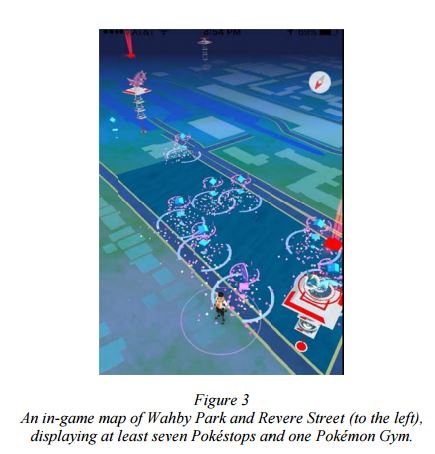
For a reason specific to this lawsuit, though, I think this Complaint has faces an additional, serious problem because the named plaintiffs do not appear to fall into the class. The plaintiffs include an illustration of the neighborhood as it appears in the app:


From this illustration, it appears that all of the PokéStops and Gyms are in the park, which is public property. The park is separated from all surrounding homes by a road. Accordingly, there appear to be no areas of private property that "abut" PokéStops or Gyms. This is a problem for the Complaint as a whole because the lead plaintiffs need to be members of that class. Plaintiffs might argue that their property falls within the 70-meter radius where people can interact with the stop or the gym, but this does not appear to fit the fairly specific, GPS-coordinate-based class definition.

I will continue to monitor both Pokémon Go class action lawsuits, and I will do my best to post updates as they proceed. I suspect that the plaintiffs in both will face some significant obstacles, but the law firm spearheading this effort doesn't appear to be slowing down at this point.

Tuesday, August 2, 2016

Evaluating the Pokemon Go Class Action Lawsuit

Several news outlets have reports on Marder v. Niantic, Inc., filed July 29, 2016 in the Federal District Court for the Northern District of California. A copy of the complaint is available here.

Coverage of the complaint is available here, here, here, and here, although the Boston Herald seems to have the most direct quotes from various people involved in the suit or otherwise wronged by Niantic's Pokemon Go app.

The Complaint outlines Pokemon Go's success, but notes that the game places "PokeStops" and "Gyms" -- locations that attract players -- on or near private property. The Complaint states that Niantic "blithely" acknowledges that players may trespass, although a round of updates a few days ago added more explicit admonishments against trespassing. The Complaint also notes several times in bold and italicized letters that "Niantic even placed three Pokéstops within the United States Holocaust Memorial Museum."

Strong stuff.

The Complaint goes on to describe the terrors inflicted on the named Plaintiff, Jeffrey Marder:

In the days following the U.S. release of Pokémon Go, Plaintiff became aware that strangers were gathering outside of his home, holding up their mobile phones as if they were taking pictures. At least five individuals knocked on Plaintiff’s door, informed Plaintiff that there was a Pokémon in his backyard, and asked for access to Plaintiff’s backyard in order to “catch” the Pokémon.
The Complaint goes on to cite other instances of Pokemon Go causing people to drive or park near people's houses, and again notes that "Niantic placed at least three Pokéstops within the United States Holocaust Memorial Museum in Washington, D.C." (emphasis [unfortunately] in the original).

Interestingly, one of the stories the Complaint cites is that of Boon Sheridan, whose house used to be a church. Sheridan reported that the game made his house into a Gym and that many players would park outside or drive slowly past. The Boston Herald managed to get in touch with Sheridan, however, and he stated that he complained to Niantic who removed the Gym designation from his house within 48 hours. Sheridan further stated that he likely would not join Marder's lawsuit.

The Complaint alleges causes of action for nuisance (invasion of the use and enjoyment of one's land) and unjust enrichment (Defendants received monetary benefits from their alleged tortious conduct). The Complaint seeks class action status for the class defined as:
All persons in the United States who own property (i) the GPS coordinates of which were designated by Defendants, without authorization, as Pokéstops or Pokémon gyms in the Pokémon Go mobile application or (ii) abutting property the GPS coordinates of which were designated by Defendants, without authorization, as Pokéstops or Pokémon gyms in the Pokémon Go mobile application.
While I will readily acknowledge that the intricacies of class action litigation are not the focus of my legal practice or research, my initial reaction is that this class definition will face an uphill battle in proving commonality among the class members. Like the class members in Wal Mart v. Dukes who were thwarted by the jump from an individual experience of sex discrimination to a business-wide policy of discrimination, here, the Plaintiff must show that class members living on or near property designated as PokeStops suffer a similar loss of enjoyment of their land. This will be difficult for Plaintiff to show.

I base this assessment on the game's design and Plaintiff's choice to limit the class definition to Plaintiffs owning property near Gyms and PokeStops. Plaintiff will be hard-pressed to show that class members tend to have people knocking on their doors in search of Pokemon as a result of PokeStops or Gyms placed on the property. Off the bat, Gyms are not a source of catching Pokemon -- players simply need to be within a certain distance of the Gym in order to interact with it. That distance used to be 100 meters, after the latest round of updates, it is apparently 70 meters. Even with the decreased distance, there should often be no need to approach or knock on the door of the property where the Gym is located.

If the property has a PokeStop, it may be the location of a "lure" module which increases the frequency of Pokemon appearing within a radius surrounding that location -- but again, the 70-meter radius is often large enough that players need not be inside the property (or within its curtilage, if I may borrow from Fourth Amendment law) to take advantage of the lure. Players can likely stand nearby on a sidewalk which, while potentially aggravating to an ornery landowner, does not appear to amount to a loss of enjoyment of the property. After all, people normally walk, stand, and allow their dogs to defecate on and near sidewalks. Increased foot traffic and the occasional presence of nostalgic hipsters is not much of a change.

In previous posts, I criticized New York State Senators for allowing their staff members to play Pokemon Go for weeks in order to generate ill-conceived policies to combat problems that do not exist. Here, however, I feel that Plaintiff and his attorneys would have done well to play the game a bit more before filing this class action. Doing so would reveal the significant obstacle to establishing the commonality element of his class definition.

And, after all, isn't this exactly what summer associates are for?

Monday, August 1, 2016

Following "Alarming" Report, New York Bans Pokemon Go for Sex Offenders on Parole

So reports Governor Andrew Cuomo's office in this press release:

Governor Andrew M. Cuomo today directed the New York State Department of Corrections and Community Supervision to restrict sex offenders under community supervision from using Pokémon GO and similar games. In an effort to safeguard New York’s children, the Governor also sent a letter to software developer Niantic, Inc. requesting their assistance in prohibiting dangerous sexual predators from playing Pokémon GO.

“Protecting New York’s children is priority number one and, as technology evolves, we must ensure these advances don't become new avenues for dangerous predators to prey on new victims," Governor Cuomo said. "These actions will provide safeguards for the players of these augmented reality games and help take one more tool away from those seeking to do harm to our children." 
At the Governor’s direction, DOCCS has imposed a new condition of parole for sex offenders under community supervision that will prohibit them from downloading, accessing, or otherwise engaging in any Internet enabled gaming activities, including Pokémon GO. The directive will apply to nearly 3,000 Level 1, 2 and 3 sex offenders currently on parole. The Department of Criminal Justice Services will additionally be providing guidance to county probation offices recommending the adoption of this policy. ​
This ban was announced almost immediately after the "Alarming Report by State Senators Jeffrey Klein and Diane Savino Detailing Dangers of Pokémon GO in Exposing New York’s Children to Sex Offenders."  As I noted in a post last Saturday, Senators Klein and Savino's report was indeed alarming -- not because it revealed that the game had actually been subjected to malicious use by sex offenders, but because it revealed the Senators' inability to keep their staff from playing a game in which they capture and battle imaginary creatures.

News outlets report on this ban here, here, and here. Douglas Berman also posts about the ban here and highlights Senator Savino's admission that "there's no evidence to any kids were sexually abused after being lured by the Pokémon app."

It's excellent to see a state government spend so much time and effort combating a problem that has not yet manifested. Additionally, it is fantastic that parole condition prohibits sex offenders on parole from downloading, accessing, or otherwise engaging in "any Internet enabled gaming activities," which would presumably include any game that requires the Internet to play, no matter whether there is any contact or potential contact with other players, both in the real world or cyberspace.

Saturday, July 30, 2016

Legislating Via Pokemon Go

The New York Times reports on an awful innovative approach to policy making:

Since its introduction this month, the app known as Pokémon Go has sent millions of players chasing after imaginary creatures in parks, city streets and, occasionally, ditches and trees.

But according to two New York State lawmakers, the game has the potential to lead children to a more frightening locale: the homes of sexual predators.

In an informal investigation by Senators Jeffrey D. Klein and Diane J. Savino, staff members took a list of 100 registered sex offenders across New York City and compared it with locations where Pokémon Go players could collect virtual items or use other game features.

In 59 cases, those locations were within half a block of offenders’ homes. The staff members, who played the game for two weeks, also found 57 Pokémon — which appear on players’ phones as if they exist in the real world — near the offenders’ homes, according to a report the senators released on Friday. Such overlap has been reported in other states, including California and North Carolina.
What is the result of the senators' inability to maintain discipline among their staff members? Why new policy of course! The Times continues:
In New York, those discoveries prompted Mr. Klein, a Democrat who represents parts of the Bronx and Westchester County, and Ms. Savino, a Staten Island Democrat, to propose two pieces of legislation, scheduled to be introduced next week. 
The first would prevent moderate or high-risk sex offenders from playing so-called augmented-reality games — like Pokémon Go — and the second would require the games’ creators to cross-reference their virtual landscapes with lists of offenders’ homes and remove any “in-game objective” within 100 feet of them.
Critics of the law point out that there have been no reports of the game leading to more crime on the part of sex offenders.

Laws targeting sex offenders are unlikely to be met with many challenges, as few groups advocate on sex offenders' behalf. And it is theoretically possible that events may come to pass in which Klein and Savino's fears are realized and Pokemon Go players who stray too close to the homes of sex offenders are victimized.

While I have heard a lot of strange stories about the trials and tribulations Pokemon Go players face, victimization at the hands of sex offenders is not an anecdote with which I am familiar. Klein and Savino's proposals may sound sensible, but they do not appear to prevent any actual harm.

Additionally, the proposal to place restrictions on the game's creators may lead to delays and restrictions on the app's use and availability in New York. While people tend not to care about hardships faced by sex offenders, Klein and Savino may face an unexpected backlash from the nostalgic hipster crowd should their restrictions on the app become law.

Merits of the proposals aside, my main reason for highlighting these policies is the awful methodology that led to their creation. Senators staff members wandered around New York and played Pokemon Go for two weeks. Indeed, here are the last few sentences of the article:
While Mr. Klein said addressing Pokémon Go would be one of his top priorities for the new legislative session in January, he also said his staff members seemed to enjoy researching the report. 
“A lot of them are very good at it,” Mr. Klein said. “They’re really into the game.”
These policies and the "work" leading to their creation are the type of government work straight out of an episode of The Thick of It. Indeed, I suspect that Klein and/or Savino started wondering where their staff members were, and a clever intern came up with the excuse that they were playing Pokemon Go as a form of policy research.

These policy proposals and their development present a rare insight into the process of policy development. I hope that I am not the only one who is appalled that government time and resources are allocated based on staff members' temporary obsession with catching imaginary creatures on their smartphones.

Tuesday, July 19, 2016

Pokemon Go Players: Beware of Binding Arbitration!

Unless you've been living under a rock or avoiding the outdoors for the past several weeks, you have probably heard of Pokemon Go, a smartphone app developed by Niantic. Pokemon Go compels 20-somethings to wander through my neighborhood at night, collide with trees, and enslave small creatures for the purpose of battling other players' small creatures. Players meander along sidewalks, streets, and beaches until they come across a Pokemon, which is superimposed on the surrounding environment through a phone's camera. For example, here is an Onix in my apartment perched on a (signed) copy of Justice Antonin Scalia and Bryan Garner's Reading Law:


What a time to be alive!

Players cavort through neighborhoods collecting items at "Poke Stops" and battling other Pokemon at Gyms. Sometimes they are mugged. The New York Times has this discussion of the history of Pokemon and the future of augmented reality games and the Wall Street Journal notes that the game is turning people into injury-prone zombies.

Legal commentary as varied as the creatures themselves is emerging as the game gains momentum. Commentators note interesting questions of property the game raises, the potential for players to injure themselves, and the risk of criminals stealing phones.

In this post, I'll focus on another line of commentary noting that those who sign up to play Pokemon Go forfeit their right to trial, agreeing instead to submit any claims to binding arbitration. Commentators note, and criticize, this portion of Niantic's Terms of Service here, here, here, and here.