Search This Blog

Showing posts with label torts. Show all posts

Monday, April 30, 2018

The Tort of "Outrage"

CNN reports that, rather than prudently disappear, failed Senate candidate and former Constitution-ignoring Alabama Chief Justice Roy Moore has filed a lawsuit:
Failed Alabama Senate candidate Roy Moore says the women who accused him of sexual assault were part of a political conspiracy, according to a lawsuit filed Monday
The suit was jointly filed with his wife, Kayla, about an hour before the two held a news conference. It was Moore's first public appearance since election night in December, when Moore, a Republican, was upset by Democrat Doug Jones.
I'm pleasantly surprised to see that CNN links to a copy of the Complaint.

I'm not going to delve into the merits of the litigation, although Moore's theory -- that it's curious that allegations against him were not raised earlier -- strikes me as flimsy. I'm sure the merits of his lawsuit have been and will be analyzed by others in far greater depth. Instead, I want to focus on Moore's sixth cause of action for "Outrage." The pertinent allegation under that cause of action states:

66. At the aforesaid times and places, Defendants—with the intent to cause severe damage to the Plaintiffs’ reputation and standing in the community—intentionally or recklessly engaged in extreme and outrageous conduct that caused emotional distress so severe that no reasonable person could be expected to endure it. Fully aware of the probable emotional impact their actions would have on the Plaintiffs, the Defendants nonetheless recklessly and willfully disregarded the consequences of their actions.
I've never heard of a cause of action for outrage, but after a bit of research it appears that Alabama courts recognize this cause of action as an alternate name for the cause of action for intentional infliction of emotional distress. The Alabama Supreme Court provides some background on this in Thomas v. BSE Indus. Contractors, Inc.:

This Court first recognized the tort of outrage, or intentional infliction of emotional distress, in American Road Service Co. v. Inmon, 394 So.2d 361 (Ala.1981). In Inmon, the Court held that to present a jury question the plaintiff must present sufficient evidence that the defendant's conduct (1) was intentional or reckless; (2) was extreme and outrageous; and (3) caused emotional distress so severe that no reasonable person could be expected to endure it. The Court defined the second element of the tort of outrage as follows: "By extreme we refer to conduct so outrageous in character and so extreme in degree as to go beyond all possible bounds of decency, and to be regarded as 1044*1044 atrocious and utterly intolerable in a civilized society." Inmon, 394 So.2d at 365 (quoting Restatement (Second) of Torts, § 46 cmt. d, at 72 (1948)).
This makes sense when you compare Moore's cause of action for outrage with the allegation underlying his cause of action for intentional infliction of emotional distress:

64. At the aforesaid times and places, and for some time prior Defendants, with the intent to cause damage to the Plaintiffs, did intentionally utter, produce, and disseminate spoken and written communications to harm the reputation and character of Roy Moore. The aforesaid outrageous and shocking acts were done with the intent of causing emotional distress and injury to Roy Moore and Kayla Moore and were a proximate cause of the Plaintiffs’ injuries as described above, herein.
Why does Moore allege two causes of action that are essentially the same? One possibility is that, until recently, Alabama courts appear to have taken a notably narrow approach to the tort of outrage.  A relatively recent opinion by the Alabama Supreme Court in Wilson v. University of Alabama Health Services Foundation held that it was error to apply too narrow of an approach to the tort:

This Court has previously recognized the tort of outrage in three circumstances:
"The tort of outrage is an extremely limited cause of action. It is so limited that this Court has recognized it in regard to only three kinds of conduct: (1) wrongful conduct in the family-burial context, Whitt v. Hulsey, 519 So. 2d 901 (Ala. 1987); (2) barbaric methods employed to coerce an insurance settlement, National Sec. Fire & Cas. Co. v. Bowen, 447 So. 2d 133 (Ala. 1983); and (3) egregious sexual harassment, Busby v. Truswal Sys. Corp., 551 So. 2d 322 (Ala. 1989). See also Michael L. Roberts and Gregory S. Cusimano, Alabama Tort Law, § 23.0 (2d ed. 1996)."
Potts v. Hayes, 771 So.2d 462, 465 (Ala. 2000). However, as Wilson notes in her brief, this Court has not held that the tort of outrage can exist in only those three circumstances: 
"That is not to say, however, that the tort of outrage is viable in only the three circumstances noted in Potts. Recently, this Court affirmed a judgment on a tort-of-outrage claim asserted against a family physician who, when asked by a teenage boy's mother to counsel the boy concerning his stress over his parents' divorce, instead began exchanging addictive prescription drugs for homosexual sex for a number of years, resulting in the boy's drug addiction. See O'Rear v. B.H., 69 So. 3d 106 (Ala. 2011). It is clear, however, that the tort of outrage is viable only when the conduct is `"so outrageous in character and so extreme in degree as to go beyond all possible bounds of decency, and to be regarded as atrocious and utterly intolerable in a civilized society."' Horne v. TGM Assocs., L.P., 56 So. 3d 615, 631 (Ala. 2010) (quoting [American Road Service Co. v.] Inmon, 394 So. 2d [361, 365 (Ala. 1980)])." 
Little v. Robinson, 72 So. 3d 1168, 1172-73 (Ala. 2011) (emphasis added).
The Court went on to overturn the trial court's holding that the cause of action for outrage is only limited to "three situations." With restrictive case law like Potts on the book, however, and with the Wilson decision only being published in December 2017, it's not surprising that a plaintiff who might not be aware of the recent Wilson decision might also want to assert a cause of action for intentional infliction of emotional distress to get around the restrictive-sounding precedent.

Additionally, the extra cause of action makes the Complaint look all the more impressive without much risk. After all, the Alabama Supreme Court in Birmingham Railway & Electric Co. v. Baylor (a case that is very old and which does not appear in full on Google Scholar and which I am not going to devote resources or time towards cite-checking),  notes that "mere redundancy will not vitiate a complaint." (at p. 494).

Moore likely won't lose anything by adding in what is essentially a restatement of his cause of action for intentional infliction of emotional distress, and will gain what appears to be an additional cause of action -- a cause of action for "Outrage," no less!

Tuesday, September 5, 2017

North Carolina Court of Appeals Rejects Constitutional Challenge to Alienation of Affections and Criminal Conversation Causes of Action

From the Washington Post:
A jilted husband’s lawsuit against a doctor accused of stealing his wife’s love can proceed after a North Carolina appeals court ruled Tuesday that the husband can continue suing the spouse’s lover, seeking damages.
The state Court of Appeals decision resurrects a lawsuit that a trial judge had thrown out in Forsyth County, whose seat is Winston-Salem. The judge ruled that state law violates a person’s constitutional free speech and free expression rights to engage in intimate sexual activity and expression with other consenting adults.
North Carolina is one of only about a half-dozen states that still allow lawsuits accusing a cheating spouse’s lover of alienation of affection and criminal conversation.
The Court of Appeals' opinion is here. From the introduction to the opinion:
This case concerns two common law causes of action—alienation of affection and criminal conversation—that permit litigants to sue the lovers of their unfaithful spouses. These laws were born out of misogyny and in modern times are often used as tools for enterprising divorce lawyers seeking leverage over the other side.

Defendant Derek Williams contends that these aging common law torts are facially unconstitutional because they violate individuals’ First and Fourteenth Amendment rights to engage in intimate sexual activity, speech, and expression with other consenting adults.
As explained below, we reject this facial constitutional challenge. Claims for alienation of affection and criminal conversation are designed to prevent and remedy personal injury, and to protect the promise of monogamy that accompanies most marriage commitments. This sets these common law claims apart from the discriminatory sodomy law at issue in Lawrence v. Texas, 539 U.S. 558 (2003), which was not supported by any legitimate state interest and instead stemmed from moral disapproval and bigotry. Similarly, these laws (in most applications) seek to prevent personal and societal harms without regard to the content of the intimate expression that occurs in the extra-marital relationship. Thus, under United States v. O’Brien, 391 U.S. 367 (1968), these torts are constitutional despite the possibility that their use burdens forms of protected speech and expression.

I have not had a chance to look through the opinion, but will do so in a later post. For now, the media outlets covering the case have failed to link to the full opinion, so hopefully anyone else who wants to write about it will see this post and link to the opinion like I did.

This case is particularly notable because a North Carolina Superior Court judge struck down an alienation of affection lawsuit in 2014 arguing that there was no rational basis for the law and noting that the law chilled protected speech. My post breaking down that decision and examining North Carolina's law is here.

From a quick glance at the Court of Appeals opinion, it looks like there is some fairly in-depth discussion of the law's First Amendment implications, which I will be interested in reading in light of my prior criticism of the law. Additionally, the fact that this is a facial challenge to the law may not foreclose future challenges -- although having an appellate decision on record upholding the law may deter lower courts from upholding such challenges. I will discuss this in more depth in a future post.

Tuesday, August 23, 2016

Can a Map Maker be Sued for Nuisance?

In a recent post I discussed whether one could sue a map maker for nuisance. For example, say a map maker were to write on a widely-distributed map that a particular house on a street corner was ugly and that people should heckle it. This would appear to constitute a nuisance under section 822 of the Restatement (Second) of Torts which states:
One is subject to liability for a private nuisance if, but only if, his conduct is a legal cause of an invasion of another's interest in the private use and enjoyment of land, and the invasion is either 
(a) intentional and unreasonable, or 
(b) unintentional and otherwise actionable under the rules controlling liability for negligent or reckless conduct, or for abnormally dangerous conditions or activities.
After a bit of digging, I found one case that involves a lawsuit for nuisance based on a map. While not identical to my hypothetical, it is close enough to be noteworthy, and is the only case of its kind of which I am aware. The case is Figlar v. Edwards, 2000 Conn. Super. LEXIS 2897 (Conn. Super Ct. 2000), and it is an unreported superior court decision from Connecticut. A publicly accessible version of the opinion is here.

The relevant facts and nuisance analysis are as follows:

The present case arises from the flooding of a parcel of property. The most recent complaint is in four counts, the first of which sounds in negligence, the second in reckless and wanton misconduct, the third in nuisance and the fourth in misrepresentation. The defendant moves to strike the second, third and fourth claims as well as two prayers for relief. 
John Figlar and John G. Howell purchased the property in question. The defendant, Larry Edwards, doing business as Larry Edwards Associates, allegedly provided "surveying and engineering services commencing from on or about August of 1991 up to and including October 1997 to the property, realtors, contractors, the planning and zoning commission of the town of Newtown, the plaintiffs and other general contractors and/or their agents and/or their advisors for purposes of developing said property . . ." The defendant subsequently filed a resubdivision map with the Newtown town clerk. 
In October 1997, Figlar and Howell commenced construction on the property and engaged the services of the defendant to design and layout the septic system in reliance on the defendant's survey. Subsequently, the septic system and the property flooded because the defendant either failed to find, or failed to indicate, that a storm water drainage system passed on, over and through the subject property.
. . .

As to the third count of the complaint which alleges, in relevant part, that: "9. The defendant, Larry Edwards, failed to disclose and/or depict the drainage easement upon the resubdivision map and that failure has a natural tendency to create a danger of flooding, damage and injury to the plaintiff property owners and the general public in the surrounding area. 10. The defendant's failure to depict this storm water drainage system on the resubdivision map created the continued and repeated dangers of flooding and damages to the plaintiffs' property and the surrounding areas. 11. The defendant, Larry Edwards, was charged to create an accurate resubdivision map of the subject area and he failed, despite knowledge to the contrary, to depict the storm water drainage system upon his resubdivision map. 12. This violation of the A-2 survey requirements and the inaccuracies of the defendant, Larry Edwards, violated the general public's rights to accurate and professional information contained in the recorded public maps and therefore also produced a common injury to the plaintiffs and the general public who relied upon him to properly depict said water drainage system and thereby allow for proper and reasonable development of land and prevention of damages and floodings." 
Both parties characterize this count as one sounding in public and private nuisance. A cause of action for private nuisance has four elements: "(1) the condition complained of had a natural tendency to create danger and inflict injury upon person or property; (2) the danger created was a continuing one; (3) the use of the land was unreasonable or unlawful; (4) the existence of the nuisance was the proximate cause of the plaintiffs' injuries and damages." (Emphasis in original; internal quotation marks omitted.) Walsh v. Stonington Water Pollution Control Authority, 250 Conn. 443, 449 n.4, 736 A.2d 811 (1999). In order to allege a public nuisance, a plaintiff must also allege the additional element that "the condition or conduct complained of interfered with a right common to the general public." Id., 459 n.9. 
The defendant asserts that because there is no allegation that the defendant owned, controlled and/or utilized any piece of land in an unreasonable fashion, the plaintiffs have failed to state a cause of action in either public or private nuisance. The plaintiffs claim that it was the maps that were the nuisance causing property. They fail to cite any authority, and the court is aware of none, for the novel argument that nuisance liability extends to those who have ownership or control over a map. The court agrees with the defendant that the plaintiffs fail to allege a necessary element of either public or private nuisance, as they do not allege that the defendant caused them any harm by way of unreasonable use of real property.
Connecticut nuisance law appears to have the added element that a defendant's conduct relate to the defendant's use of land. Accordingly, a defendant who interferes with another's enjoyment of property in some manner that does not involve the use of land cannot be liable for nuisance.

Under the Restatement definition of nuisance, however, I suspect that the Figlar plaintiff may have a viable cause of action. The Restatement does not require that the defendant own or use land in a certain manner, and if the plaintiff's allegations are correct, the defendants may well be liable for their failure to disclose a drainage easement if it results in damage to the plaintiff's property.

Friday, August 19, 2016

"Virtual Property," "Virtual Trespass," and Nuisance Law: A Pokémon Go Story

This post is a spinoff from some of my recent posts on Pokémon Go litigation which you can find here and here. Pokémon Go's popularity and related litigation has prompted commentators to discuss notions of "virtual property," and related questions of who owns virtual property and whether it can be invaded in instances of "virtual trespass." I think that "virtual property" and "virtual trespass" are poor choices of wording that lead to confused discussions and the breakdown of legal analysis.

My suggestion: stop using these terms. Rather than "virtual property," instead say, "right to enjoyment of property." Rather than "virtual trespass," instead say, "interference with the right to enjoyment of property." In short, nuisance law provides an effective avenue for coherent legal treatment and analysis of Pokémon Go and other augmented reality games. Notions of trespass lead to confusion and unanswerable questions.

For the story that prompted these legal musings, CTV News reports:
A French mayor has denounced the "anarchical settlement" of "Pokemon Go" characters on the "territory" of his eastern village and has ordered the game's creator to remove the virtual creatures.

Bressolles Mayor Fabrice Beauvois said Tuesday that he has mailed a decree to California-based Niantic Inc. and The Pokemon Company to make sure they stop setting up Pokemons [sic] in the village of about 800 inhabitants northeast of Lyon.

In his decree, the mayor says the search for Pokemons [sic] puts pedestrians and drivers at risk because players get inattentive while watching their smartphones and that it may also result in groups of people forming at night
You can find additional reporting on the decree here and here.

The article goes on to note that while Niantic has not responded regarding the mayor's request, Niantic has pointed out that people can request that the company remove a location's designation as a Gym or PokéStop. This solution, however, would not address that mayor's concern, who is requesting that the "territory" of his village be removed from the App's augmented reality altogether.

Here's the logic the mayor used:

"When a cafe or a restaurant owner wants to open a business in any French town, they have an obligation to request prior authorization to the mayor. The rule applies to all people wishing to set up an activity or occupy a space on a public property. So it applies to Niantic as well, even though their settlement is virtual," Beauvois said.

The argument illustrates an interesting question: does Pokémon Go's placement of interactive locations and randomly-generated digital creatures onto a map constitute trespass or interference with property rights? Keith Lee confronts this question in this excellent article.

One of the particularly interesting questions Lee raises goes as follows:

You might argue that [Augmented Reality] object[s] aren’t real. That they don’t constitute a physical invasion of property. But:
  • To recover in trespass for an intangible invasion to property, a plaintiff must show: (1) an invasion affecting an interest in exclusive possession; (2) the act resulting in the invasion was intentional; (3) reasonable foreseeability that the act could result in an invasion of the plaintiff’s possessory interest; and (4) substantial damage to the property. Borland v. Sanders Lead Co., Inc., 369 So. 2d 523, 2 A.L.R.4th 1042 (Ala. 1979).
Does your exclusive rights to property extend to cyberspace? Can someone place lights, sounds, objects, that are only viewable with technology assistance, on your property without your permission?

As Lee's final question indicates, the notion of "virtual space," when viewed through the lens of augmented reality games like Pokémon Go, leads to mind-bending questions over the definition and extent of "trespass." The interactive nature of augmented reality certainly lends an intuitive push towards accepting the trespass analogy. But taking a step back, putting down the phone, and taking a broader look at how the augmented reality system works leads to a breakdown in applying the logic of trespass. People's houses are not being overrun by small creatures, Pokéballs are not flying through windows -- people's physical property is not being invaded. Without the invasion, the trespass analogy breaks down.

Property owners, however, are not without a remedy. The law of property is not limited to physical property and its invasion. The law of nuisance extends to one's property rights, and interference with those rights. It is through nuisance, not trespass, that property owners may successfully argue that Niantic is causing them harm.

A series of illustrations may help clarify the argument. I'll start with an example involving one of the first forms of augmented reality technology: maps.

Wednesday, August 17, 2016

Michigan Residents File Pokemon Go Class Action Lawsuit

The attorneys at Pomerantz Law are at it again, and are attorneys of record in a Michigan class action lawsuit against Niantic and Nintendo. The allegations in the Michigan complaint overlap significantly with those in a Massachusetts class action lawsuit that I blogged about at the beginning of August filed by a Massachusetts resident. Both complaints were filed in the District Court for the Northern District of California.

Click On Detroit reports about the new class action -- which also alleges causes of action for nuisance and unjust enrichment -- filed by a Michigan couple living in St. Claire Shores, a suburban town located near Detroit that will be holding a Fence Arbitration meeting today for those who may have forgotten to mark their calendars. Reporting by Bloomberg Markets (on the lawsuit, not the Fence Arbitration meeting) can be found here.

A copy of the Complaint can be found attached to the Click on Detroit article. Its substance significantly overlaps with the Massachusetts Complaint, and it too includes multiple bold, italicized mentions of how "Niantic even placed three Pokéstops within the United States Holocaust Memorial Museum." That part never gets old.

One improvement in the Michigan Complaint is that it has more facts regarding how Pokémon Go affected the plaintiffs' lives. As you may recall, the Massachusetts Plaintiff's allegations were little more than a complaint about several people walking near his house and knocking on his door on a few occasions. The Michigan Complaint is more detailed. The factual allegations are largely copied from letters the Plaintiffs wrote to Niantic, and here is an example of some of that quoted language. Trigger warning: bold italics:

At any given moment there are at least a couple of hundred people in the park play[ing] this game, compared to the average of at least 15-20 in the park. The [Pokéstops and Pokémon gyms] . . . [are] an open invitation for the players to utilize our street, our lawns, looking in our windows . . . and so forth. There are at least 30 homes . . . that are affected by this. These players are loud, make threats, [are] intrusive, and I do not feel safe. My husband and I moved to our home almost two years ago because it was peaceful, quite, and safe. When I see people driving slow, looking into our home, walking on our property, looking into our vehicles, we do not feel safe. Neither do the neighbors. . . .

. . .

With all the traffic it is hard to tell who is playing the game, or casing out our street/park, someone who is looking to rob, rape or any other harm. . . . They park along our street that borders Wahby Park, we ask them to move and get threats and attitudes. I was threatened by a man who refused to leave. He was parked in front of my home. I had hardly any room to back out of my driveway. Mind you, he was also parked the wrong way on the street. . . . I truly hope you will take this into consideration, the news has already been in the park twice, and have interviewed neighbors on this issue.
To paraphrase, the plaintiffs live near Wahby Park which, in addition to being a great place for weddings, allegedly has six PokéStops, where players can collect items and place "lures" that attract Pokémon. This has led to a crisis of numerous people going to the park, and wreaking havoc in the surrounding neighborhood. Plaintiffs allege that players are walking on their yards, blocking driveways, and even include a picture of a potential hipster giving side-eye to the camera.

Yikes.

Plaintiffs seek to establish a class and use the same definition as the Massachusetts Plaintiff, which is:
All persons in the United States who own property (i) the GPS coordinates of which were designated by Defendants, without authorization, as Pokéstops or Pokémon gyms in the Pokémon Go mobile application or (ii) abutting property the GPS coordinates of which were designated by Defendants, without authorization, as Pokéstops or Pokémon gyms in the Pokémon Go mobile application.
For reasons I explain at length in this prior post, I think this class definition is likely to fail.

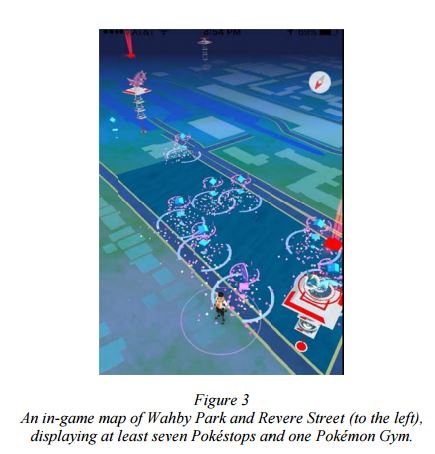
For a reason specific to this lawsuit, though, I think this Complaint has faces an additional, serious problem because the named plaintiffs do not appear to fall into the class. The plaintiffs include an illustration of the neighborhood as it appears in the app:


From this illustration, it appears that all of the PokéStops and Gyms are in the park, which is public property. The park is separated from all surrounding homes by a road. Accordingly, there appear to be no areas of private property that "abut" PokéStops or Gyms. This is a problem for the Complaint as a whole because the lead plaintiffs need to be members of that class. Plaintiffs might argue that their property falls within the 70-meter radius where people can interact with the stop or the gym, but this does not appear to fit the fairly specific, GPS-coordinate-based class definition.

I will continue to monitor both Pokémon Go class action lawsuits, and I will do my best to post updates as they proceed. I suspect that the plaintiffs in both will face some significant obstacles, but the law firm spearheading this effort doesn't appear to be slowing down at this point.

Tuesday, August 2, 2016

Evaluating the Pokemon Go Class Action Lawsuit

Several news outlets have reports on Marder v. Niantic, Inc., filed July 29, 2016 in the Federal District Court for the Northern District of California. A copy of the complaint is available here.

Coverage of the complaint is available here, here, here, and here, although the Boston Herald seems to have the most direct quotes from various people involved in the suit or otherwise wronged by Niantic's Pokemon Go app.

The Complaint outlines Pokemon Go's success, but notes that the game places "PokeStops" and "Gyms" -- locations that attract players -- on or near private property. The Complaint states that Niantic "blithely" acknowledges that players may trespass, although a round of updates a few days ago added more explicit admonishments against trespassing. The Complaint also notes several times in bold and italicized letters that "Niantic even placed three Pokéstops within the United States Holocaust Memorial Museum."

Strong stuff.

The Complaint goes on to describe the terrors inflicted on the named Plaintiff, Jeffrey Marder:

In the days following the U.S. release of Pokémon Go, Plaintiff became aware that strangers were gathering outside of his home, holding up their mobile phones as if they were taking pictures. At least five individuals knocked on Plaintiff’s door, informed Plaintiff that there was a Pokémon in his backyard, and asked for access to Plaintiff’s backyard in order to “catch” the Pokémon.
The Complaint goes on to cite other instances of Pokemon Go causing people to drive or park near people's houses, and again notes that "Niantic placed at least three Pokéstops within the United States Holocaust Memorial Museum in Washington, D.C." (emphasis [unfortunately] in the original).

Interestingly, one of the stories the Complaint cites is that of Boon Sheridan, whose house used to be a church. Sheridan reported that the game made his house into a Gym and that many players would park outside or drive slowly past. The Boston Herald managed to get in touch with Sheridan, however, and he stated that he complained to Niantic who removed the Gym designation from his house within 48 hours. Sheridan further stated that he likely would not join Marder's lawsuit.

The Complaint alleges causes of action for nuisance (invasion of the use and enjoyment of one's land) and unjust enrichment (Defendants received monetary benefits from their alleged tortious conduct). The Complaint seeks class action status for the class defined as:
All persons in the United States who own property (i) the GPS coordinates of which were designated by Defendants, without authorization, as Pokéstops or Pokémon gyms in the Pokémon Go mobile application or (ii) abutting property the GPS coordinates of which were designated by Defendants, without authorization, as Pokéstops or Pokémon gyms in the Pokémon Go mobile application.
While I will readily acknowledge that the intricacies of class action litigation are not the focus of my legal practice or research, my initial reaction is that this class definition will face an uphill battle in proving commonality among the class members. Like the class members in Wal Mart v. Dukes who were thwarted by the jump from an individual experience of sex discrimination to a business-wide policy of discrimination, here, the Plaintiff must show that class members living on or near property designated as PokeStops suffer a similar loss of enjoyment of their land. This will be difficult for Plaintiff to show.

I base this assessment on the game's design and Plaintiff's choice to limit the class definition to Plaintiffs owning property near Gyms and PokeStops. Plaintiff will be hard-pressed to show that class members tend to have people knocking on their doors in search of Pokemon as a result of PokeStops or Gyms placed on the property. Off the bat, Gyms are not a source of catching Pokemon -- players simply need to be within a certain distance of the Gym in order to interact with it. That distance used to be 100 meters, after the latest round of updates, it is apparently 70 meters. Even with the decreased distance, there should often be no need to approach or knock on the door of the property where the Gym is located.

If the property has a PokeStop, it may be the location of a "lure" module which increases the frequency of Pokemon appearing within a radius surrounding that location -- but again, the 70-meter radius is often large enough that players need not be inside the property (or within its curtilage, if I may borrow from Fourth Amendment law) to take advantage of the lure. Players can likely stand nearby on a sidewalk which, while potentially aggravating to an ornery landowner, does not appear to amount to a loss of enjoyment of the property. After all, people normally walk, stand, and allow their dogs to defecate on and near sidewalks. Increased foot traffic and the occasional presence of nostalgic hipsters is not much of a change.

In previous posts, I criticized New York State Senators for allowing their staff members to play Pokemon Go for weeks in order to generate ill-conceived policies to combat problems that do not exist. Here, however, I feel that Plaintiff and his attorneys would have done well to play the game a bit more before filing this class action. Doing so would reveal the significant obstacle to establishing the commonality element of his class definition.

And, after all, isn't this exactly what summer associates are for?

Tuesday, July 19, 2016

Pokemon Go Players: Beware of Binding Arbitration!

Unless you've been living under a rock or avoiding the outdoors for the past several weeks, you have probably heard of Pokemon Go, a smartphone app developed by Niantic. Pokemon Go compels 20-somethings to wander through my neighborhood at night, collide with trees, and enslave small creatures for the purpose of battling other players' small creatures. Players meander along sidewalks, streets, and beaches until they come across a Pokemon, which is superimposed on the surrounding environment through a phone's camera. For example, here is an Onix in my apartment perched on a (signed) copy of Justice Antonin Scalia and Bryan Garner's Reading Law:


What a time to be alive!

Players cavort through neighborhoods collecting items at "Poke Stops" and battling other Pokemon at Gyms. Sometimes they are mugged. The New York Times has this discussion of the history of Pokemon and the future of augmented reality games and the Wall Street Journal notes that the game is turning people into injury-prone zombies.

Legal commentary as varied as the creatures themselves is emerging as the game gains momentum. Commentators note interesting questions of property the game raises, the potential for players to injure themselves, and the risk of criminals stealing phones.

In this post, I'll focus on another line of commentary noting that those who sign up to play Pokemon Go forfeit their right to trial, agreeing instead to submit any claims to binding arbitration. Commentators note, and criticize, this portion of Niantic's Terms of Service here, here, here, and here.

Thursday, July 9, 2015

San Diego 'Zombie Walk' Cancelled as Criminal Case and Lawsuit Looms

So reports NBC San Diego and Fox 5. In previous years the "Zombie Walk," has been a popular attraction associated with Comic-Con. In the Zombie Walk, undead enthusiasts dress as zombies and march through the streets of San Diego.

Unfortunately, during last year's Zombie Walk, Matthew Pocci drove through a crowd of participants, injuring one of them. Pocci claims that he became scared by the crowd of zombie walkers around him and tried to speed away after they banged on his car and tried to get inside. Zombie Walk organizers counter that video of the incident did not show any participants near the vehicle before it sped into the crowd. In the aftermath of this incident, a fast-approaching criminal trial date for Pocci, and a lawsuit by the victim against Pocci and the City of San Diego, this year's Zombie Walk has been cancelled.

In the meantime, the OC Register reports that a "Walker Stalker Con" will take place at the same time as Comic-Con. Various stars of AMC's "The Walking Dead" will be present at this parallel event, which celebrates a series centered around the struggle for survival in a post-apocalyptic, zombie-infested world.

While the Comic-Con horde of zombies has been subdued by legal machinations, I suspect that there will be at least several participants at the Walker Stalker Con who don zombie garb in celebration of all things undead. So while the official Zombie Walk has been cancelled, I would not be surprised to see some form of a zombie walk take place during Comic-Con this year.

Wednesday, February 11, 2015

Is it Constitutional to Prosecute Those Who Mail Cow Manure?

My attempt at answering this age-old legal question is prompted by this story about a pair of feuding Iowa couples. Here is the report:
A southeast Iowa couple who were sent cow manure in the mail have sued the woman who acknowledges that she paid to have the poop sent.

The Hawk Eye reports that Mary Eipert and Steven Rowland want a judge to order Kimberly Capdevila and her husband, Carlos, to stop their dog from barking all day and night. The lawsuit filed Monday seeks compensatory and monetary damages for the barking and for what the lawsuit says is harassment by the Capdevilas.

The two couples are neighbors who have been squabbling over the barking dog. Fifty-one-year-old Kimberly Capdevila has said she had the manure sent as a practical joke. She has pleaded not guilty to a misdemeanor charge of harassment. She’s due back in court on April 7 for pretrial conference.
In this post I will briefly discuss the aspects of the Rowlands' civil claim, but then move on to discuss the criminal side of this story. I will look into the crime that Kimberly Capdevila has most likely been charged with, whether the prosecution has a strong case, and whether prosecuting Capdevila under this law is constitutional.

Monday, October 20, 2014

Parents' Liability for Their Children's Online Conduct

The Wall Street Journal Law Blog has this interesting post about Boston v. Athearn, a recent case from the Court of Appeals of Georgia. From the Law Blog:
The Georgia Court of Appeals ruled that the parents of a seventh-grade student may be negligent for failing to get their son to delete a fake Facebook profile that allegedly defamed a female classmate. 
The trouble started in 2011 when, with the help of another student, the boy constructed a Facebook profile pretending to be the girl. He used a “Fat Face” app to make her look obese and posted profane and sexually explicit comments on the page depicting her as racist and promiscuous, according to court documents. 
When the girl found out about it, she told her parents who then complained to the school’s principal. The school punished the boy with two days of in-school suspension and alerted his parents, who grounded him for a week. 
But for the next 11 months, according to the appeals court opinion, the page stayed up. It wasn’t deleted until Facebook deactivated the account at the urging of the girl’s parents, the opinion said. The girl’s lawyer says the child’s parents didn’t immediately confront the boy’s parents because their school refused to identify the culprit for confidentiality reasons.
The full opinion of the court is available here.

The court emphasized that the parents had been notified of their child's online conduct, and pointed out that the nature of online defamation created an ongoing harm to the plaintiffs. From the opinion:
In this case, it is undisputed that Dustin used a computer and access to an Internet account improperly, in a way likely to cause harm, and with malicious intent. The Ahearns contend that they had no reason to anticipate that Dustin would engage in that conduct until after he had done so, when they received notice from the school that he had been disciplined for creating the unauthorized Facebook profile. Based on this, they contend that they cannot be held liable for negligently supervising Dustin’s use of the computer and Internet account. The Ahearns’ argument does not take into account that, as Dustin’s parents, they continued to be responsible for supervising Dustin’s use of the computer and Internet after learning that he had created the unauthorized Facebook profile. While it may be true that Alex was harmed, and the tort of defamation had accrued, when even one person viewed the false and offensive postings, it does not follow that the Athearns’ parental duty of reasonable supervision ended with the first publication.

Given the nature of libel, the original tortious conduct may continue to unfold as the false and injurious communication is published to additional readers or the defamatory content persists in a public forum without public correction or retraction. With regard to the instant action, we conclude that a reasonable jury could find that, after learning on May 10, 2011, of Dustin’s recent misconduct in the use of the computer and Internet account, the Ahearns failed to exercise due care in supervising and controlling such activity going forward. Given that the false and offensive statements remained on display, and continued to reach readers, for an additional eleven months, we conclude that a jury could find that the Athearns’ negligence proximately caused some part of the injury Alex sustained from Dustin’s actions (and inactions). Accordingly, the trial court erred in granting the Athearns’ motion for summary judgment in part. (footnotes omitted).
Critics have spoken out against this ruling, arguing that it is undesirable or that the negligence lawsuit should have been barred by section 230 of the Communications Decency Act (CDA). I think that this ruling is far less problematic than the critics have argued, and I explain my reasoning after the break.

Tuesday, September 30, 2014

Moot Court Competitors Sue Competition Organizers Over "Arbitrary and Blasphemous" Interpretation of Rules

Bar and Bench reports that several students from KLE Society's Law College have sued the principal of BMS College of Law over an unfavorable moot court competition outcome. It seems that the KLE students won against their opponents in the semifinal round of the competition, but ended up not advancing to the final round of the competition. From the article:

It all started in the semi-final rounds of the B M Sreenivasaiah Memorial National Moot Court Competition, organized by BMS Law College in March this year. At the end of the semi-final rounds, KLE Society's moot teem was left flummoxed, wondering how the sweetness of victory could turn into that despicable feeling of being cheated. Having beaten their opponents convincingly in the smi-final round, the team were in for a rude shock. They were told that the losing semi-finalist of the other round would go through to the final rounds, on the basis of cumulative marking. In the opinion of the BMS Principal, the term "knock out" meant that the organizers have the power to eliminate a team on the basis of cumulative marking.

The aggrieved KLE Society students have filed suit for a declaratory judgment that their loss was due to an unfair interpretation of the competition's rules. They are also suing for emotional suffering. From paragraph 16 of the complaint (included in the Bar and Bench Article):

That, the Plaintiffs despite having performed exceedingly well, by the arbitrary and blasphemous attitude and actions of the First Defendant had to bear the pain and suffering of a loss which they were not entitled to. Injustice was inflicted blatantly and the First Defendant having no remorse whatsoever just dismissed the Plaintiffs without providing a suitable remedy.
The complaint itself is extremely dramatic, and a delight to read. Here is another excerpt -- this time from paragraph 18:

Lawlessness prevailed in a law college and the Plaintiffs deeply condemn this attitude of theirs. If the Defendants intended to change and interpret the rules like the way they wanted to, they should at least have had the decency and courtesy to inform the Plaintiffs of the same before the competition began, failing which they have miserably failed in upholding the principles of law which they boast of teaching in their institution.
It seems to me like the competition's organizers' reading of the rules was strained, and perhaps arbitrary. But I doubt that the KLE students' dramatic, litigious response will help improve their reputations in the legal community.

Thursday, September 18, 2014

Ninth Circuit: CDA Section 230 Does Not Bar Failure to Warn Lawsuit Against Website

Under Section 230 of the Communications Decency Act (CDA), websites are generally not liable for harm caused by content posted by third parties. This is because the CDA provides that websites will not be treated as the publishers of that content for purposes of liability. 

To illustrate, if I post something defamatory on this blog, the person I defame may have a viable claim against me, but not against Blogspot or Google, the platforms on which this blog is run. I explain this law in more detail here.

Every once in a while, courts find that a website encourages the third party's harmful statements in such a way that the website can be liable. But these decisions are a rare exception to the general rule.

Yesterday, the Ninth Circuit released the opinion Doe v. Internet Brands, Inc., an important case that illuminates the boundaries of websites' immunity. While websites may be shielded from lawsuits that concern the statements of third parties, the websites may be liable in failure to warn lawsuits, since those causes of action do not require the inference that the website was the publisher of third parties' statements. While I think that the opinion reaches a correct result, the Ninth Circuit maintains that its reasoning is consistent with the underlying goals of section 230 -- a claim over which I have some doubts.

Wednesday, September 17, 2014

Jimmy John's Sprouts Class Action Results in Cookie Settlement

These are the terms of a settlement agreement reached by Jimmy Johns in light of a recent class action lawsuit filed against the sandwich chain.

Heather Stark claimed that she ordered a sandwich containing sprouts and did not get sprouts on her sandwich. Rather than ask for sprouts or a new sandwich, Stark did what any red-blooded American would do and sued, arguing (according to the settlement agreement):

 (1) interference with contract; (2) intentional misrepresentation; (3) negligent misrepresentation, (4) fraud; (5) violation of California’s False Advertising Act, California Business and Professions Code sections 17500, et seq.; (6) violation of California’s Business and Professions Code sections 17200, et seq.; (7) Violation of California’s Consumers Legal Remedies Act, Civil Code sections 1750, et seq.; and (8) Violation of the federal Lanham Act, 15 U.S.C. § 1125. 

As a brief note on the last count of the complaint, it has always been my understanding that consumers typically lack standing to sue under the Lanham Act, and causes of actions arising under this statute are limited to business competitors (see, for example, commentary on the law here and here).

Unfortunately, lawyers would probably charge tens of thousands of dollars to make that point in court. So Jimmy Johns has proposed a settlement agreement which you can read here. Here is the part that everybody should know:

Without admitting liability, Defendant has agreed to provide vouchers to any Jimmy John’s restaurants, with a face value of $1.40 and good for any side item (pickle, potato chips or cookie) or soda, to all participating claimants who timely complete the online claim form available on www.jimmyjohns.com, up to a maximum of $725,000.00 less the actual costs of the settlement administration.
The rest of the settlement agreement goes on to say that the fairness of this settlement will be evaluated in court on December 4, 2014.

Admittedly the vouchers can be used to purchase a variety of items, but the quality of Jimmy John's cookies renders all the other options void. Because of this, and because I am mindful of those who have suffered without sprouts, I encourage my readers to pay careful attention to the progress of this litigation.

Thursday, September 11, 2014

Texas Courts Can Order Removal of Defamatory Material Posted Online

So holds the Texas Supreme Court in Kinney v. Barnes. The full text of the opinion is available here. Texas Lawyer reports that court orders for the removal of online content is a new remedy for defamed parties. Texas Lawyer goes on to note that the opinion still holds that courts cannot enjoin any future online speech since that would be an unlawful prior restraint, something that the Supreme Court has roundly rejected (see footnote 7 of the opinion).

From the opinion:
In this case, Kinney’s request for injunctive relief may be broken down into two categories. First, as reflected in the pleadings, Kinney would have the trial court order Barnes to remove the statements at issue from his websites (and request that third-party republishers of the statements do the same) upon a final adjudication that the statements are defamatory. Such an injunction does not prohibit future speech, but instead effectively requires the erasure of past speech that has already been found to be unprotected in the context in which it was made. As such, it is accurately characterized as a remedy for one’s abuse of the liberty to speak and is not a prior restraint.
While injunctive relief is typically not available in defamation cases, ordering the removal of posted defamatory material seems to be a sensible exception to the general rule. Were the statement to remain online, courts would need to estimate the continuing damage the statement could cause, or re-adjudicate the case if harm continued to occur as a result of the statement. Ordering the removal of a defamatory statement may at least partially mitigate some of this continuing harm.

Tuesday, September 9, 2014

An Early Version of Sexual Harassment Law in the Ecclesiastical Courts

From R.H. Helmholz's Roman Canon Law in Reformation England, (Cambridge Univ. Press, 1990), I learned about the process of ex officio proceedings in the English Ecclesiastical Courts in the sixteenth century. Helmholz writes that these proceedings concerned the "enforcement of the Church's rules relating to morality and personal conduct" (104) and covered a wide range of offenses.

The sixteenth century saw an expansion of ex officio proceedings and enforcement. Helmholz writes:

Conduct in and around one's parish church was more closely regulated by the ecclesiastical courts than had once been true. Interrupting the parson's sermon, throwing a snowball in the churchyard, sitting obstinately in the wrong seat, wearing one's hat during the reading of the Gospel, even being a "common sleeper" during church services; all could subject the offender to a required appearance before a spiritual tribunal. A mother's failure to appear for "churching" after the birth of a child was cause for citing her. So was marrying in a church during a prohibited time of the year. Equally punishable was speaking abusively against the churchwardens. The best that any of these offenders could hope for from the courts was dismissal with a warning not to repeat the conduct. They almost always had to pay court fees, and very often to contribute something towards relief of the poor. Elizabethan and Jacobean act books, though dominated by the prosaic sexual offences that were their medieval inheritance yet made room for new wrongs. (112-13) (footnotes omitted).
As Helmholz mentions at the end of that passage, ex officio proceedings had historically been concerned with sexual offenses. And while new prosecutions arose for different types of conduct, the sexual offense prosecutions remained.

Helmholz notes that new types of prosecutions arose in the sexual offense category as well:

Birth of the tort of "attempting the chastity" of a woman also belongs to this period. The terseness of most act book entries makes it difficult to generalize about the offence, but it is clear that it required no use or even threat of force. Little more than a serious and perhaps persistent proposition of sexual relations seems to have been all that lay behind most such prosecutions. A man from the diocese of Bath and Wells, for example, was prosecuted in 1621 for having so "very earnestly" solicited the chastity of a woman that she could allege an inability to "go quiet" on his account. A few of the ex officio causes tempt one to see in them antecedents of the modern notion of "sexual harassment." (111-12) (footnotes omitted).
From other research that I have been doing in the area of character evidence in sex offense cases (related to the issue I discuss in this post), I have learned in painful detail just how the early English courts, and early American courts, left a great deal to be desired when it came to treating women with respect. In light of this, it is interesting to learn about the existence of a tort under which men could be punished for propositioning women absent any physical force or threats of physical force. 

Knowing about the sad state of early law towards women deemed "unchaste," I expect that there were still many sexual propositions that went unpunished. But the existence of a tort that punishes sexual propositions is an interesting nuance in the history of this area of law.

Wednesday, August 20, 2014

Invasion of Privacy From Posting Honeymoon Photos on Facebook

I have a new post up at Techlawgic. Here is the outline:

An Italian court recently ordered a woman to remove photos of her and her husband on their honeymoon because the husband did not give his permission for her to post the photos. 
This decision, which is 'unprecedented' in Italian law, would almost certainly fail in the United States. 
This case may illustrate differing views on privacy between the United States and Europe, or it may simply be incorrect.
In the post, I describe how these facts would not give rise to a successful action for invasion of privacy under misappropriation and intrusion on seclusion theories. An article on the case I write about is available here.

Thursday, July 31, 2014

July 2014: Bar Exam Apocalypse - Day 3

Today was the final day of the California Bar Exam. Cheers erupted when the proctor said the three incredible words, "You are dismissed." I fought a final time through the sea of people to get to the one, narrow escalator that carried me up and away to freedom.

ExamSoft's awful treatment of the bar exam now has a hashtag -- #Barghazi -- so I guess that all the hype is real. Coverage is available from more sources here, here, here, and Deadspin.

Since California is one of the few remaining states administering the bar exam today, I found that uploading the exams was not as cumbersome as it was on Tuesday, although I did get a strange error-looking message with strings of incoherent text after my files were uploaded. The website says that I'm good to go, though, so I hope that this is the last time I need to deal with them.

As far as natural and man-made disasters are concerned, today was not as dramatic as days one and two. But a building-wide fire alarm at 3:30 a.m. was still rather upsetting, and I eventually fell back to sleep wondering if I could sue everybody in my apartment building on a res ipsa loquitur theory.

The bar exam is over, and over the next few days I will be moving to Orange County and then going on a vacation to Lake Tahoe until next Friday. Blogging may be light because of this, though now that bar exam studying is finished, I may end up turning to the blog in order to fill the void.

Congratulations to all of the law students who survived this year's Bar Exam Apocalypse! I'll let you know in November if everything turned out okay.

Wednesday, July 30, 2014

July 2014: Bar Exam Apocalypse - Day 2

The fallout over yesterday's ExamSoft disaster continues, with the legal blogosphere chiming in on the matter. Jonathan Adler predicts that students who do not pass may end up suing ExamSoft, which is something I will keep in mind if the exam doesn't turn out the way I want it to. Coverage from the Wall Street Journal law blog is available here.

Yesterday, I suggested that the end is near (in an apocalyptic sense), in light of this software meltdown and massive flooding at UCLA. Today, for the most part, things seemed better, although I learned this evening that we had a bit of a close call:


This seems to have happened right at the beginning of the lunch break -- and the epicenter was far enough away that the impact was minimal at my testing location. But it is still a worrisome sign, especially since those of us in California (unlike most of the country) still have one more day of testing to go.

Thursday, July 24, 2014

Criminal Punishment for the Theft of Virtual Items?

From Erica Buist at The Guardian:

All right, own up: did you steal Mike Weatherley's sword on World of Warcraft? If so, you'd better watch out. He's really upset about it. So much so that, as David Cameron's chief adviser on intellectual property, he has asked ministers to consider passing a law that would mean people "who steal online items in video games with a real-world monetary value receive the same sentences as criminals who steal real-world items of the same monetary value".

. . .


"If you've spent £500 building up your armed forces and someone takes them away online, I guess you can feel hard done-by and you want your £500 back," he told Buzzfeed. He also pointed out: "The perception from some people is that if you steal online it's less of a crime than if you steal physically." 
It's hard to argue with his logic. Gamers spend a lot of money on virtual items, and invest time in building armed forces or gigantic warships. These things may be nothing more than a collection of pixels on a screen, but the money isn't virtual, and neither is the time, or the feeling of having been robbed.
Buzzfeed also covers this proposed law.

I agree that some aspects of online theft are similar to theft in the real world. Many online items are purchased with real money. Thieves can steal these goods under the pretense of exchanging or trading items, but then leaving upon receipt of the valuable goods. This entry in a World of Warcraft forum is an example of such a fraudulent transaction. Law students studying for the bar should recognize this as something resembling the quirky crime of larceny by trick.

But there are crucial differences between the theft of physical items or money and the theft of virtual goods in an online environment. Blizzard, the company that makes many of these online games, warns players of these online scams, but also says that they will "assist where possible" when a scam can be verified. And as the players in the earlier forum mention, if there is a chat record that details the fraudulent transaction, the player can usually receive another copy of their virtual good, and the person who stole the good will probably be banned.

If somebody can receive an identical copy of their stolen good once it is stolen, and if offenders face effective exile from the online world in which the theft takes place, I am not sure that prosecuting online thieves would be a constructive undertaking. It makes sense to criminalize online theft that results in the loss of money from a person's bank account (say in instances of identity theft). But when the theft deprives somebody of a virtual item that can be replaced with an identical item without cost to the website, the theft, while fraudulent, does not seem to cause enough harm to warrant criminal prosecution.